
# Story Explained
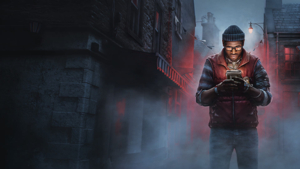
Silent Hill: Townfall tells the story of Simon Ordell, who returns to the Scottish island town of St. Amelia in 1996 to "put things right." What follows is a layered narrative of industrial tragedy, supernatural horror, and deeply personal reckoning. This guide breaks down the major plot points, themes, and theories surrounding the game's story.
The game is set entirely in first-person perspective, played through fog-laden streets and nightmarish Otherworld environments. Simon wakes near the docks with only a medical wristband bearing his name and no clear memory of the town, adding to the mystery of his return.
Plot Overview
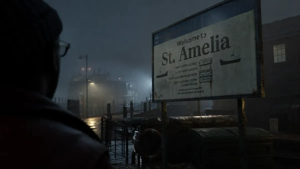
Simon Ordell arrives in St. Amelia, a remote Scottish coastal settlement established as a fictional island town, with a mysterious purpose. Upon arrival, he finds himself trapped in a nightmare -- the town is shrouded in fog, haunted by monstrous creatures, and periodically shifts into a hellish Otherworld dominated by industrial imagery and a deep red hue.
As Simon explores the town, he uncovers the history of a catastrophic industrial disaster connected to CEG (a corporate entity involved in oil drilling operations). The disaster froze the town in time at exactly 8:19:45 AM, trapping it in a state between reality and nightmare.
Simon's journey takes him through several key locations, including the Haldane Hotel (where he holds a key to Room 204), various industrial facilities, and the ever-shifting boundary between the Fog World and the Otherworld. According to Konami's press materials, the game features multiple endings shaped by the player's actions throughout the experience.

Key Story Elements
### The Haldane Hotel
The Haldane Hotel is central to the narrative:
- Named after a Scottish family from the 12th century
- The family clan crest bears the motto "SUFFER"
- Simon has a key to Room 204, suggesting a deep personal connection to the hotel
- After the CEG disaster, the hotel was converted into an emergency medical center when the town's hospital was overwhelmed by casualties
The hotel serves as a physical and symbolic bridge between the town's past and present, its luxury origins giving way to its role as a place of suffering and triage.
### The Otherworld and Industrial Horror
The Otherworld in Townfall is distinctly tied to St. Amelia's industrial history:
- Large metal pipes dominate the landscape, representing oil drilling infrastructure
- The dominant red hue creates a hellish atmosphere
- The industrial imagery suggests that the town's nightmare is a manifestation of the CEG disaster's trauma
The Otherworld raises a key question: is it a reflection of Simon's personal guilt, the collective trauma of the town's victims, or something more fundamental about the nature of reality in St. Amelia?
### "I Woke Up in the Water Again"
Simon's recurring statement -- "I woke up in the water again, but... this time it's... different" -- is one of the most significant narrative clues. The word "again" implies:
- Simon has experienced this before, suggesting a time loop or cyclical event
- Each iteration may be slightly different ("this time it's... different")
- The water imagery connects to Simon's arrival on the island and the maritime setting
This line supports the theory that Simon's journey is not a single linear experience but a repeating cycle, with each loop offering the possibility of a different outcome -- reflected in the game's multiple endings system.
### The Spiral and Nautilus Symbolism
The nautilus shell and the CEG corporate logo both feature spiral imagery. This spiral motif connects to:
- The cyclical nature of Simon's experience
- The concept of descent -- both literal (into the Otherworld) and metaphorical (into truth)
- The CEG's role in the town's catastrophe, with the spiral representing the company's inescapable influence
### 8:19:45 AM -- The Frozen Moment
All clocks in St. Amelia stopped at 8:19:45 AM, believed to be the exact moment of the CEG disaster. This detail suggests:
- The town is trapped in the moment of catastrophe
- Reality in St. Amelia is anchored to this single point in time
- The supernatural events are an eternal replay of the disaster's trauma
### Celtic Symbolism
The game incorporates Celtic iconography that enriches the narrative:
- Trinity Knot: Represents eternity, unity, and the interconnection of mind, body, and spirit. May connect to the three story endings.
- Celtic Knot: Symbolizes endlessness and cyclical journeys, reinforcing the loop theory.
These symbols ground the supernatural elements in authentic Scottish cultural tradition, distinguishing Townfall from the American folklore of previous Silent Hill games.
Character Motivations
### Simon Ordell
Simon's stated purpose is to return to St. Amelia to "put things right." However, the full nature of what needs putting right is gradually revealed through gameplay. His connection to the Haldane Hotel and Room 204 suggests he has a personal history with the town that predates his arrival in the game.
Simon's journey is described as "very much about introspection" by voice actor Jovan Adepo, indicating that the external horrors of the Otherworld mirror internal psychological struggles.
### Zoe Ellis
Zoe serves as a major companion character, accompanying Simon through portions of the game. Her role appears to be both practical (assisting in navigation and survival) and thematic (representing a connection to the present that anchors Simon amidst the supernatural chaos).
### Richard
Richard is a pivotal character whose full role in the narrative is revealed gradually. Voiced by Terry O'Quinn, Richard appears to have knowledge of the town's history and Simon's connection to it.
Major Theories
### The Loop Theory
The most prominent theory suggests that Simon is trapped in a time loop, repeatedly reliving the events surrounding the CEG disaster. Evidence includes:
- The "again" in Simon's opening line
- The cyclical Celtic symbolism
- The multiple endings suggesting different iterations of the same events
- The frozen time at 8:19:45 AM
### The Collective Trauma Theory
This theory posits that the Otherworld is a manifestation of the collective trauma of St. Amelia's inhabitants. The industrial imagery represents the disaster, the monsters represent the victims, and Simon's journey is an attempt to process and resolve this shared suffering.
### The Personal Purgatory Theory
Under this interpretation, Simon's experience in St. Amelia is a form of personal purgatory -- a supernatural trial designed to force him to confront his own guilt and responsibility for the town's tragedy. The multiple endings represent different levels of acceptance and atonement.
Franchise Connections
Townfall's story maintains connections to the broader Silent Hill franchise:
- Radio static identical to Silent Hill 2 and 3 signals supernatural presence
- Nightmare world design shares visual DNA with the original Silent Hill's fence structures
- The game continues the series' tradition of using a specific town as a crucible for psychological horror
- The multiple endings system echoes the branching conclusions of Silent Hill 2
Critical Reception
The story has been widely praised:
- Described as "Alien Isolation in Silent Hill" for its tense atmosphere and immersive first-person perspective
- The Scottish setting adds freshness while maintaining the franchise's core identity
- Voice acting and narrative depth have been highlighted as standout qualities
- The attention to detail in environmental storytelling has drawn particular acclaim