
# Lore and St. Amelia History
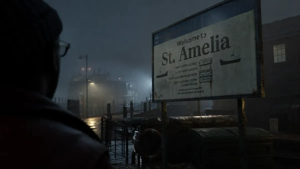
St. Amelia is the fictional Scottish coastal settlement that serves as the primary setting for Silent Hill: Townfall. Set in 1996, this remote island town brings a distinctly Scottish atmosphere to the franchise, with its own rich history, industrial past, and supernatural secrets. Unlike the American locations of previous Silent Hill games, St. Amelia's Scottish heritage adds unique cultural depth to the horror narrative.

Overview of St. Amelia
St. Amelia is a remote island town in Scotland, established as a coastal settlement with deep ties to industrial operations. The town's history is deeply intertwined with oil drilling -- specifically operations managed by CEG (a corporate entity) -- and a catastrophic event that fundamentally altered the fabric of the town and its inhabitants.
The game's first-person perspective and atmospheric design create an immersive experience of the town's fog-laden streets, abandoned buildings, and the nightmarish Otherworld that lurks beneath the surface. According to Konami's official materials, Silent Hill: Townfall launches on September 24, 2026, for PlayStation 5 and PC via Steam and Epic Games Store, with the Deluxe Edition offering 48-hour early access starting September 21.
The CEG Disaster
The central tragedy in St. Amelia's history is connected to CEG (a corporate/industrial entity) and what appears to have been a catastrophic industrial accident. Evidence from the game suggests the disaster involved:
- Oil drilling operations -- The Otherworld is dominated by large metal pipes consistent with oil infrastructure
- Chemical leakage or explosion -- The exact nature of the disaster is debated, but the industrial setting points to a catastrophic failure
- Mass casualties -- The scale of the disaster was significant enough to overwhelm local medical facilities
The Haldane Hotel reportedly became an impromptu medical center after the CEG disaster overloaded the town's hospital, suggesting the event caused mass casualties requiring emergency triage. This transformation from luxury accommodation to emergency facility underscores the severity of the catastrophe.
The CEG Disaster
The central tragedy in St. Amelia's history is connected to CEG (a corporate/industrial entity) and what appears to have been a catastrophic industrial accident. Evidence from the game suggests the disaster involved:
- Oil drilling operations -- The Otherworld is dominated by large metal pipes consistent with oil infrastructure
- Chemical leakage or explosion -- The exact nature of the disaster is debated, but the industrial setting points to a catastrophic failure
- Mass casualties -- The scale of the disaster was significant enough to overwhelm local medical facilities
The Haldane Hotel reportedly became an impromptu medical center after the CEG disaster overloaded the town's hospital, suggesting the event caused mass casualties requiring emergency triage.
The Haldane Hotel
The Haldane Hotel is one of the most significant locations in St. Amelia's lore:
- The surname "Haldane" is a Scottish name dating back to the 12th century
- The clan crest motto is "SUFFER" -- a word that carries heavy thematic weight in the context of the game
- Simon Ordell possesses a key to Room 204, connecting him directly to the hotel's history
- After the CEG disaster, the hotel served as an emergency medical facility when the hospital was overwhelmed
The hotel appears to be a nexus point for the supernatural events in St. Amelia, serving as a bridge between the town's industrial past and its haunted present.
Time Frozen at 8:19 AM
One of the most striking pieces of lore is that all clocks in St. Amelia stopped at 8:19:45 AM. This is believed to be the exact time of the CEG accident, suggesting:
- The town is frozen in time at the moment of the catastrophe
- St. Amelia may exist in a state of limbo -- neither fully real nor fully Otherworld
- The supernatural events are a manifestation of the town's trauma, replaying endlessly
The specificity of the time (8:19:45 AM) adds to the sense that the town's reality is anchored to a single, traumatic moment.
The Otherworld
The Otherworld in Townfall has distinct characteristics that connect to St. Amelia's industrial history:
- Dominant red hue -- Consistent with the Silent Hill franchise's tradition of rust-colored nightmare worlds
- Large metal pipes -- Suggesting oil drilling operations, directly tying the nightmare realm to the town's industrial past
- Connection to the CEG disaster -- The Otherworld appears to be a manifestation of the trauma and destruction caused by the catastrophe
The Otherworld's design raises questions about whether it represents Simon's personal psyche, the collective trauma of St. Amelia's inhabitants, or something else entirely.
Celtic Iconography
The game incorporates Celtic symbols that add layers of meaning to the lore:
### Trinity Knot - Represents eternity, unity, and the interconnection of mind, body, and spirit - The three-fold nature may connect to the game's three story endings - Suggests cyclical themes of death and rebirth
### Celtic Knot - Symbolizes endlessness and cyclical journeys - Reinforces the theory that Simon's experience may be a loop or recurring cycle - Connects to the Scottish setting, grounding the supernatural elements in authentic cultural symbolism
The Spiral and Nautilus Connection
The nautilus shell and the CEG logo both feature spiral imagery, suggesting a connection between the corporate entity and the cyclical nature of the town's supernatural events. This spiral motif reinforces themes of:
- Descent into darkness (literally descending into the Otherworld)
- The inescapable nature of the town's curse
- The recursive structure of Simon's journey
Scottish Setting and Authenticity
The choice of a Scottish island town as the setting has been widely praised:
- The authenticity of the Scottish atmosphere adds a fresh dimension to the Silent Hill franchise
- The industrial history of oil drilling provides a unique backdrop for the supernatural horror
- The Celtic cultural elements create a distinct mythological framework separate from the American settings of previous games
- The isolation of an island town amplifies the sense of claustrophobia and inescapability
Supernatural Mechanics
The lore of St. Amelia connects to several gameplay mechanics:
- CRTV System -- Surveillance cameras and monitors that reveal hidden truths about the town
- Fog World -- The eerie, mist-covered version of St. Amelia that serves as the game's primary exploration environment
- Static sounds -- Audio cues identical to those in Silent Hill 2 and 3, signaling supernatural presence
- IV drip health system -- Medical imagery that connects to the town's history of trauma and the Haldane Hotel's role as an emergency medical center
Community Theories
The Silent Hill community has developed several theories about St. Amelia's lore:
- The town exists in a time loop, with Simon reliving the same events repeatedly
- The CEG disaster created a rift between dimensions, allowing the Otherworld to bleed into reality
- The Celtic iconography suggests the supernatural forces predate the industrial operations
- Simon's connection to Room 204 in the Haldane Hotel may indicate he was present during the original disaster